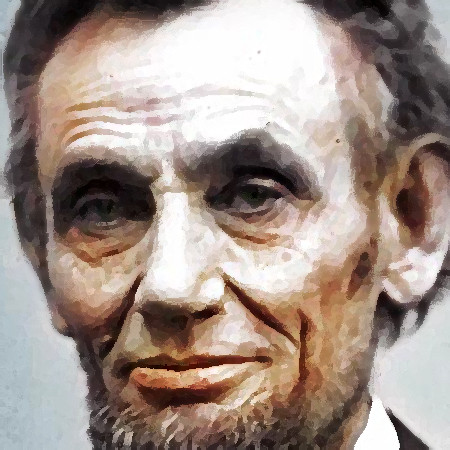
Classic Jon Stewart
| The Daily Show With Jon Stewart | M - Th 11p / 10c | |||
| Baracknophobia - Obey | ||||
| ||||
Labels: Barack Obama, corruption, Dick Cheney, George W. Bush, GOP, Jon Stewart, President Obama, The Daily Show, tyranny

Let every American, every lover of liberty, every well wisher to his posterity, swear by the blood of the Revolution, never to violate in the least particular, the laws of the country; and never to tolerate their violation by others.
As the patriots of seventy-six did to the support of the Declaration of Independence, so to the support of the Constitution and Laws, let every American pledge his life, his property, and his sacred honor; let every man remember that to violate the law, is to trample on the blood of his father, and to tear the charter of his own, and his children's liberty.
Let reverence for the laws, be breathed by every American mother, to the lisping babe, that prattles on her lap; let it be taught in schools, in seminaries, and in colleges; let it be written in Primers, spelling books, and in Almanacs; let it be preached from the pulpit, proclaimed in legislative halls, and enforced in courts of justice. And, in short, let it become the political religion of the nation; and Let the old and the young, the rich and the poor, the grave and the gay, of all sexes and tongues, and colors and conditions, sacrifice unceasingly upon its altars.
While ever a state of feeling, such as this, shall universally, or even, very generally prevail throughout the nation, vain will be every effort, and fruitless every attempt, to subvert our national freedom.- Abraham Lincoln, January 27, 1838
Address Before the Young Men's Lyceum of Springfield, Illinois
| The Daily Show With Jon Stewart | M - Th 11p / 10c | |||
| Baracknophobia - Obey | ||||
| ||||
Labels: Barack Obama, corruption, Dick Cheney, George W. Bush, GOP, Jon Stewart, President Obama, The Daily Show, tyranny
Labels: George W. Bush, over, presidency, Thank God
Visit msnbc.com for Breaking News, World News, and News about the Economy
Labels: George W. Bush, Iraq, Keith Olbermann, presidency, Special Commentary
Labels: George W. Bush, Jon Stewart, President, The Daily Show
Labels: George W. Bush

Labels: George W. Bush, get off our lawn, Larry King
A President Forgotten but Not Gone
By FRANK RICH
WE like our failed presidents to be Shakespearean, or at least large enough to inspire Oscar-worthy performances from magnificent tragedians like Frank Langella. So here, too, George W. Bush has let us down. Even the banality of evil is too grandiose a concept for 43. He is not a memorable villain so much as a sometimes affable second banana whom Josh Brolin and Will Ferrell can nail without breaking a sweat. He’s the reckless Yalie Tom Buchanan, not Gatsby. He is smaller than life.
The last NBC News/Wall Street Journal poll on Bush’s presidency found that 79 percent of Americans will not miss him after he leaves the White House. He is being forgotten already, even if he’s not yet gone. You start to pity him until you remember how vast the wreckage is. It stretches from the Middle East to Wall Street to Main Street and even into the heavens, which have been a safe haven for toxins under his passive stewardship. The discrepancy between the grandeur of the failure and the stature of the man is a puzzlement. We are still trying to compute it.
More...
Labels: commentary, Frank Rich, George W. Bush, New York Times
Labels: Barack Obama, Britain, Bush, comedy, George W. Bush, Robin Williams, UK
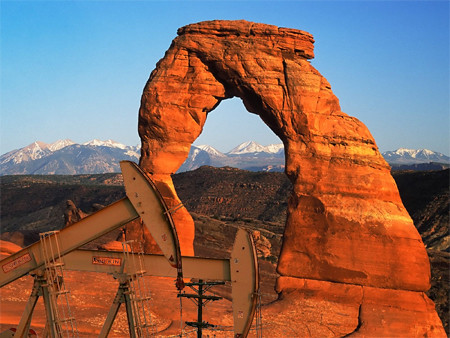
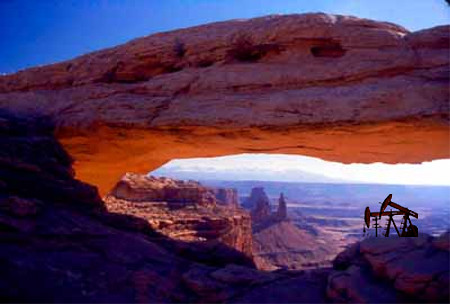
Fire Sale! Everything must go!(AP) The view of Delicate Arch natural bridge - an unspoiled landmark so iconic it's on Utah's license plates - could one day include a drilling platform under a proposal that environmentalists call a Bush administration "fire sale" for the oil and gas industry.
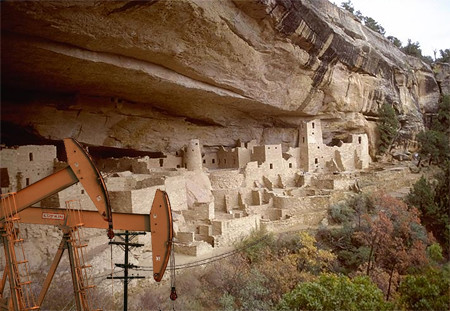
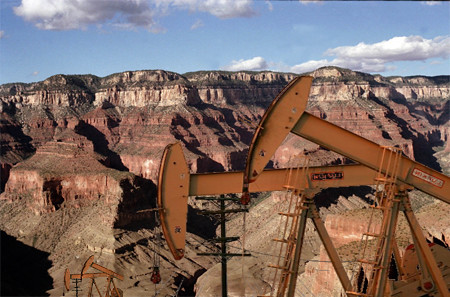
Late on Election Day, the U.S. Bureau of Land Management announced a Dec. 19 auction of more than 50,000 acres of oil and gas parcels alongside or within view of Arches National Park and two other redrock national parks in Utah: Dinosaur and Canyonlands.
The National Park Service's top official in the state calls it "shocking and disturbing" and says his agency wasn't properly notified. Environmentalists call it a "fire sale" for the oil and gas industry by a departing administration.


Labels: Big Oil, BLM, Cheney, drill baby drill, George W. Bush, National Parks, Oil
My great concern is not whether you have failed, but whether you are content with your failure.[1]
There are no accidents in my philosophy. Every effect must have its cause. The past is the cause of the present, and the present will be the cause of the future. All these are links in the endless chain stretching from the finite to the infinite.[2]
I have borne a laborious, and, in some respects to myself, a painful part in the contest [the war between the States.] Through all, I have neither assailed, nor wrestled with any part of the Constitution.[3]
I freely acknowledge myself the servant of the people, according to the bond of service -- the United States Constitution; and that, as such, I am responsible to them.[4]
I have never understood that the Presidency conferred upon me an unrestricted right to act.[5]
It was in the oath I took that I would, to the best of my ability, preserve, protect, and defend the Constitution of the United States. I could not take the office without taking the oath. Nor was it my view that I might take an oath to get power, and break the oath in using the power.[6]
We find ourselves under the government of a system of political institutions, conducing more essentially to the ends of civil and religious liberty, than any of which the history of former times tells us. We, when mounting the stage of existence, found ourselves the legal inheritors of these fundamental blessings.
We toiled not in the acquirement or establishment of them---they are a legacy bequeathed us, by a once hardy, brave, and patriotic, but now lamented and departed race of ancestors. Their's was the task (and nobly they performed it) to possess themselves, and through themselves, us, of this goodly land; and to uprear upon its hills and its valleys, a political edifice of liberty and equal rights; 'tis ours only, to transmit these, the former, unprofaned by the foot of an invader; the latter, undecayed by the lapse of time, and untorn by usurpation---to the latest generation that fate shall permit the world to know. This task of gratitude to our fathers, justice to ourselves, duty to posterity, and love for our species in general, all imperatively require us faithfully to perform.
How, then, shall we perform it? At what point shall we expect the approach of danger? By what means shall we fortify against it? Shall we expect some transatlantic military giant, to step the Ocean, and crush us at a blow? Never! All the armies of Europe, Asia and Africa combined, with all the treasure of the earth (our own excepted) in their military chest; with a Buonaparte for a commander, could not by force, take a drink from the Ohio, or make a track on the Blue Ridge, in a trial of a thousand years.
At what point then is the approach of danger to be expected? I answer, if it ever reach us, it must spring up amongst us. It cannot come from abroad. If destruction be our lot, we must ourselves be its author and finisher. As a nation of freemen, we must live through all time, or die by suicide.[7]
Let me first state what I understand to be your position. It is, that if it shall become necessary, to repel invasion, the President may, without violation of the Constitution, cross the line, and invade the teritory of another country; and that whether such necessity exists in any given case, the President is to be the sole judge.
Before going further, consider well whether this is, or is not your position.
Allow the President to invade a neighboring nation, whenever he shall deem it necessary to repel an invasion, and you allow him to do so, whenever he may choose to say he deems it necessary for such purpose---and you allow him to make war at pleasure.
Study to see if you can fix any limit to his power in this respect, after you have given him so much as you propose. If, to-day, he should choose to say he thinks it necessary to invade Canada, to prevent the British from invading us, how could you stop him? You may say to him, "I see no probability of the British invading us'' but he will say to you "be silent; I see it, if you don't.''
The provision of the Constitution giving the war-making power to Congress, was dictated, as I understand it, by the following reasons. Kings had always been involving and impoverishing their people in wars, pretending generally, if not always, that the good of the people was the object.
This, our Convention understood to be the most oppressive of all Kingly oppressions; and they resolved to so frame the Constitution that no one man should hold the power of bringing this oppression upon us. But your view destroys the whole matter, and places our President where kings have always stood.[8]
Has it [popular sovereignty] not got down as thin as the homeopathic soup that was made by boiling the shadow of a pigeon that had starved to death?[9]
The question of Revenue we will now briefly consider.
For several years past, the revenues of the Government have been unequal to its expenditures, and consequently, loan after loan, sometimes directly, and sometimes indirectly in form, have been resorted to. By this means a new National debt, has been created, and is still growing on us with a rapidity fearful to contemplate---a rapidity only reasonably to be expected in time of war.
This state of things has been produced by a prevailing unwillingness, either to increase the tariff, or resort to direct taxation. But the one or the other must come. Coming expenditures must be met, and the present debt must be paid; and money cannot always be borrowed for these objects.
The system of loans is but temporary in its nature, and must soon explode. It is a system, not only ruinous while it lasts, but one that must soon fail and leave us destitute. As an individual who undertakes to live by borrowing, soon finds his original means devoured by interest, and next no one left to borrow from---so must it be with a government.[10]
What constitutes the bulwark of our own liberty and independence? It is not our frowning battlements, our bristling sea coasts, the guns of our war steamers, or the strength of our gallant and disciplined army. These are not our reliance against a resumption of tyranny in our fair land. All of them may be turned against our liberties, without making us stronger or weaker for the struggle.
Our reliance is in the love of liberty which God has planted in our bosoms. Our defense is in the preservation of the spirit which prizes liberty as the heritage of all men, in all lands, every where. Destroy this spirit, and you have planted the seeds of despotism around your own doors.
Familiarize yourselves with the chains of bondage, and you are preparing your own limbs to wear them. Accustomed to trample on the rights of those around you, you have lost the genius of your own independence, and become the fit subjects of the first cunning tyrant who rises.[11]
I know the American People are much attached to their Government;---I know they would suffer much for its sake;---I know they would endure evils long and patiently, before they would ever think of exchanging it for another.
Yet, notwithstanding all this, if the laws be continually despised and disregarded, if their rights to be secure in their persons and property, are held by no better tenure than the caprice of a mob, the alienation of their affections from the Government is the natural consequence; and to that, sooner or later, it must come. [12].
Let us then turn this government back into the channel in which the framers of the Constitution originally placed it.[13]
There is a spirit in the people, sometimes slumbering, but never extinct, which, when thoroughly aroused by usurpation or tyranny, will overwhelm the usurper and his devices in an undistinguished ruin; nor can they long escape this generous indignation, who prostitute the power bestowed by the people to unworthy ends or selfish purposes.[14]
I believe you do not mean to be unjust, or ungenerous; and I, therefore am slow to believe that you will not yet think better and think differently of this matter.[15]

Labels: Abraham Lincoln, Constitution, George W. Bush, law
On Friday, the U.S. Supreme Court overruled an attempt by Republicans to challenge the validity of 200,000 voter registrations in Ohio, saying that the party lacked the standing to sue.
The Republicans had sued to force Ohio Secretary of State Jennifer Brunner, a Democrat, to provide county election officials with lists of registrants whose personal information did not exactly match Social Security or driver's license data, a step that would leave those voters vulnerable to eligibility challenges.
Tensions began to escalate Thursday with disclosures that the FBI is investigating ACORN and the possibility that it's engaged in a vote-fraud scheme.
On Friday, Obama's legal counsel, Robert Bauer, wrote Attorney General Michael Mukasey, charging that the inquiry is politically motivated and that it risks repeating the 2007 scandal over the Bush administration's politicization of the Justice Department.
Bauer asked Mukasey to broaden a special prosecutor's investigation to examine the origin of the ACORN inquiry.
President George W. Bush late Friday asked Attorney General Michael Mukasey to investigate whether hundreds of thousands of newly registered voters in the battleground state of Ohio would have to verify the information on their voter registration forms or be given provisional ballots, an issue the U.S. Supreme Court weighed in on last week.
The unprecedented intervention by the White House less than two weeks before the presidential election may result in at least 200,000 voters in Ohio not being able to vote on Election Day. Information on the 200,000 voter registration forms does not match up exactly with information on government databases. Republicans are claiming that's evidence of voter registration fraud.
But the mismatched information can be attributed to misspellings and other minor mistakes, not a malicious intent on the part of voters to cast fraudulent ballots.
Still, House Minority Leader John Boehner, R-Ohio, sent a letter to Bush Friday asking that he order the Department of Justice to probe the matter claiming Ohio election officials are not complying with federal law. Boehner wants Mukasey to order the Ohio Secretary of State to identify the 200,000 voters by county and precinct and be given a provisional ballot until their registrations are confirmed. Provisional ballots largely go uncounted.
“I strongly urge you to direct Attorney General Mukasey and the Department of Justice to act." Boehner said in his letter “Unless action is taken by the Department immediately, thousands, if not tens or hundreds of thousands of names whose information has not been verified through the [Help America Vote Act] procedures mandated by Congress will remain on the voter rolls during the November 4 election; and there is a significant risk if not a certainty, that unlawful votes will be cast and counted. Given the Election Day is less than two weeks away, immediate action by the Department is not only warranted, but also crucial.”
Independent studies have shown that phony registrations rarely result in illegally cast ballots because there are so many other safeguards built into the system.
Labels: 2008 election, George W. Bush, John Boehner, John McCain, Mukasey, Ohio, SCOTUS, Supreme Court, voter registration
Labels: 2008 election, Barack Obama, campaign, George W. Bush, John McCain
While the people retain their virtue, and vigilance, no administration, by any extreme of wickedness or folly, can very seriously injure the government, in the short space of four years.
- Abraham Lincoln
Labels: Abraham Lincoln, Barack Obama, Democratic Party, Democrats, economy, George W. Bush, quote
Labels: Al Gore, George W. Bush, GOP, Impeachment, Shock Doctrine
Statement on Congressional Approval of BailoutDifficult or impossible.
by: Dean Baker, The Center for Economic and Policy Research
Friday 03 October 2008
This is the first time in the history of the United States that the president has sought to provoke a financial panic to get legislation through Congress. While this has proven to be a successful political strategy, it marks yet another low point in American politics.
It was incredibly irresponsible for President Bush to tell the American people on national television that the country could be facing another Great Depression. By contrast, when we actually were in the Great Depression, President Roosevelt said that, "we have nothing to fear, but fear itself."
It was even more irresponsible for him to seize on the decline in the stock market five days later as evidence that his bailout was needed for the economy. President Bush must surely understand, as all economists know, that the daily swings in the stock market are driven by mass psychology and have almost nothing to do with the underlying strength in the economy.
The scare tactics of President Bush, Secretary Paulson and Federal Reserve Board Chairman Bernanke created sufficient panic, so that by the time of the vote, much of the public believed that the defeat of the bailout may actually have had serious consequences for the economy. Millions of people have changed their behavior because of this fear, with many pulling money out of bank and money market accounts, and in other ways adjusting their financial plans.
This effort to promote panic is especially striking since the country's dire economic situation is almost entirely the result of the Bush Administration's policy failures. First and foremost, the decision of Secretary Paulson and Chairman Bernanke (and previously Alan Greenspan) to ignore the housing bubble, allowed for the growth of an $8 trillion bubble, which is now collapsing.
It is the collapse of this bubble, which has already destroyed more than $4 trillion in housing wealth, and is likely to destroy another $4 trillion over the next year, that is at the root of the economy's problems. While competent economists were warning of the bubble and the dire consequences of its collapse, the top officials in the Bush administration were celebrating the rise in homeownership rates.
The Bush administration made the crisis even worse by deregulating Wall Street. This led to the huge over-leveraging of financial institutions, which has vastly complicated the country's economic policies. It is especially disturbing that Secretary Paulson personally profited from these policies, earning hundreds of millions in compensation from Goldman Sachs during his years there as its CEO.
The collapse of the housing bubble, while falling short of the magnitude of the Great Depression, is likely to lead to the worst recession since World War II. Repairing the damage caused by this bubble will be a long and difficult process. Cleaning up the damage to the political system from President Bush's unprecedented fear campaign may prove to be even more difficult.
Labels: Abraham Lincoln, Bush, Dean Baker, George W. Bush, ghost, government bailout, Lincoln, Wall Street, White House

The President has seemed underinformed, disconnected and not, you should excuse the word, invested. In his address to the nation Wednesday evening, he said that the government was blameless for the financial crisis; it had done what it was supposed to do but had been victimized by overseas lenders, greedy banks and Americans taking on more credit than they could carry. And as he has done too often before, he tried to make us afraid.
"The government's top economic experts warn that without immediate action by Congress, America could slip into a financial panic, and a distressing scenario would unfold." President Bush said. "More banks could fail, including some in your community. The stock market would drop even more, which would reduce the value of your retirement account. The value of your home could plummet. Foreclosures would rise dramatically. And if you own a business or a farm, you would find it harder and more expensive to get credit. More businesses would close their doors, and millions of Americans could lose their jobs."
Contrast what he had to say with President Franklin Delano Roosevelt when he was sworn into office for the first time, in 1933, during the Great Depression. Rather than foster anxiety and panic, FDR proclaimed, "The only thing we have to fear is fear itself," despite the fact that 13 million were unemployed, nine million had lost their savings and a quarter of the banks had closed. Wages had plummeted 60 percent. "The only thing we have to fear is fear itself" is the phrase that everyone remembers, but here's a little more of what FDR had to say:
"This is preeminently the time to speak the truth, the whole truth, frankly and boldly. Nor need we shrink from honestly facing conditions in our country today. This great Nation will endure, as it has endured, will revive and will prosper ...
"In such a spirit on my part and on yours we face our common difficulties. They concern, thank God, only material things. Values have shrunk to fantastic levels; taxes have risen; our ability to pay has fallen; government of all kinds is faced by serious curtailment of income ... More important, a host of unemployed citizens face the grim problem of existence and an equally great number toil with little return. Only a foolish optimist can deny the dark realities of the moment ...
"The money changers have fled from their high seats in the temple of our civilization. We may now restore that temple to the ancient truths. The measure of that restoration lies in the extent to which we apply social values more noble than mere monetary profit ... If I read the temper of our people correctly, we now realize, as we have never realized before, our interdependence on each other; that we can not merely take, but we must give as well."
Read the rest
Labels: FDR, fear, fiancial crash, financial crisis, Franklin Delano Roosevelt, George W. Bush, Wall Street
Labels: Bush, fear, fear mongering, financial crash, financial crisis, George W. Bush, Iraq, Jon Stewart, The Daily Show, Wall Street
September 26, 2008
Talks Implode During a Day of Chaos; Fate of Bailout Plan Remains Unresolved
WASHINGTON — The day began with an agreement that Washington hoped would end the financial crisis that has gripped the nation. It dissolved into a verbal brawl in the Cabinet Room of the White House, urgent warnings from the president and pleas from a Treasury secretary who knelt before the House speaker and appealed for her support.
“If money isn’t loosened up, this sucker could go down,” President Bush declared Thursday as he watched the $700 billion bailout package fall apart before his eyes, according to one person in the room.
It was an implosion that spilled out from behind closed doors into public view in a way rarely seen in Washington.
By 10:30 p.m., after another round of talks, Congressional negotiators gave up for the night and said they would try again on Friday. Left uncertain was the fate of the bailout, which the White House says is urgently needed to fix broken financial and credit markets, as well as whether the first presidential debate would go forward as planned Friday night in Mississippi.
When Congressional leaders and Senators John McCain and Barack Obama, the two major party presidential candidates, trooped to the White House on Thursday afternoon, most signs pointed toward a bipartisan agreement on a grand compromise that could be accepted by all sides and signed into law by the weekend. It was intended to pump billions of dollars into the financial system, restoring liquidity and keeping credit flowing to businesses and consumers.
“We’re in a serious economic crisis,” Mr. Bush told reporters as the meeting began shortly before 4 p.m. in the Cabinet Room, adding, “My hope is we can reach an agreement very shortly.”
But once the doors closed, the smooth-talking House Republican leader, John A. Boehner of Ohio, surprised many in the room by declaring that his caucus could not support the plan to allow the government to buy distressed mortgage assets from ailing financial companies.
Mr. Boehner pressed an alternative that involved a smaller role for the government, and Mr. McCain, whose support of the deal is critical if fellow Republicans are to sign on, declined to take a stand.
The talks broke up in angry recriminations, according to accounts provided by a participant and others who were briefed on the session, and were followed by dueling news conferences and interviews rife with partisan finger-pointing.
Friday morning, on CBS’s “The Early Show,” Representative Barney Frank of Massachusetts, the lead Democratic negotiator, said the bailout had been derailed by internal Republican politics.
“I didn’t know I was going to be the referee for an internal G.O.P. ideological civil war,” Mr. Frank said, according to The A.P.Thursday, in the Roosevelt Room after the session, the Treasury secretary, Henry M. Paulson Jr., literally bent down on one knee as he pleaded with Nancy Pelosi, the House Speaker, not to “blow it up” by withdrawing her party’s support for the package over what Ms. Pelosi derided as a Republican betrayal.
“I didn’t know you were Catholic,” Ms. Pelosi said, a wry reference to Mr. Paulson’s kneeling, according to someone who observed the exchange. She went on: “It’s not me blowing this up, it’s the Republicans.”
Read more...
Labels: Barney Franks, financial crash, financial crisis, George W. Bush, Henry Paulson, John Boehner, John McCain, Nancy Pelosi, Wall Street
Breaking News Alert
The New York Times
Wednesday, September 24, 2008 -- 9:15 PM ET
-----
Bush Asks Americans to Support Bailout
In a speech to the nation, President Bush calls on Americans to support the economic recovery plan. Mr. Bush has invited presidential candidates John McCain and Barack Obama, as well as top lawmakers, to the White House for economic crisis talks on Thursday.
Labels: George W. Bush, King George, Wall Street
By Bruce Fein
Tuesday, September 16, 2008
COMMENTARY:
If the United States neglects to rethink its purpose informed by the genius and practice of the Founding Fathers, it is destined to self-destruct like every other empire from hubris and overreach. At present, the Republic is undergoing a metamorphosis into executive despotism featuring escalating taxes and permanent warfare because of staggering ignorance of the nation's birth certificate among officeholders, candidates and the public.
The Constitution's preamble explains that the national interest of the United States lies in providing for the "common defense" and "secur[ing] the blessings of liberty to ourselves and our posterity." The Founding Fathers denied that the United States was saddled with either a moral or legal responsibility to implant freedom throughout the planet.
None ever hinted at a national duty to overthrow the French Bourbons, the Russian Romanovs, or the Ottoman Sultans. Nor did they believe Americans would be made either safer or freer by attempting to cram American democracy down the throats of feudalistic, tribal, sectarian or autocratic foreign political cultures, for example, Afghanistan, Iraq, Russia or China. The exercise would be futile because the knowledge needed to pluck the flower of democracy from the nettle of longstanding tyranny is beyond human grasp.
Further, these utopian larks would make Americans less safe and less free. Military interventions abroad make enemies by the inevitable killing of innocent civilians in pursuit of actual enemies. Think of the mounting "collateral damage" deaths in Afghanistan or Iraq. Resentments are also awakened by the insult to national dignity implicit in American military bases or occupation forces - a variation of "The Ugly American" by Eugene Burdick and William Lederer.
In addition, the trillions of dollars squandered in foreign military frolics subtract from fashioning a virtually invulnerable defense posture at home earmarked by spy satellites and aircraft, anti-missile systems, submarines, upgraded border security, sophisticated intelligence collection, and a credible threat to destroy any enemy nation with the audacity to attack.
Finally, the military exertions necessary to effectuate an endless American crusade for democracy abroad would be the death knell of the republic. War endows the president with invincible power at home. He controls the public record of information through selective disclosures of classified intelligence. He awards military honors and contracts. And he commands popular political support by exploiting the natural patriotism and fears of Americans that he manufactures by logarithmically inflating foreign threats.
A president with unchecked authority spies on political opponents, flouts the rule of law, cripples the congressional power of oversight, and, arbitrarily detains, harasses or punishes citizens or noncitizens alike on his say-so alone.
In sum, the United States would have become a mirror of the tyranny that provoked the Declaration of Independence if its mission was the global expansion of liberty.
President Bush epitomizes the light years the United States has traveled from its more modest founding purpose and the Constitution's injunctions. Bob Woodward reports in his new book "The War Within": "The opportunity to spread freedom throughout the globe, and particularly in the broader Middle East and in the Muslim world," [Bush's National Security Adviser Stephen] Hadley said that day, "that is, I think for the president, the defining idea of his presidency... it is not only a sort of moral duty, it's not only consistent with our principles, it's consistent with our interests, it's actually essential for our national security. ... For liberty to be secure at home, liberty has to be on the march abroad. Big stuff. Not big. Huge." But President Bush's ambitions are also delusional, ill-founded and extra-constitutional.
Not a syllable in the Constitution or Declaration of Independence, however, suggests the president has either the duty or authority to carry freedom to the four corners of the Earth. And Mr. Bush's concoction of a moral obligation is unconvincing. The United States did not create the dictatorships, autocracies or lawlessness that afflict Egypt, Libya, Sudan, Somalia, Zimbabwe, Eritrea, Ethiopia or Syria. It is not morally bound to relieve afflictions it did not create.
Further, that messianic task would contradict the nation's principles as expounded by the Founding Fathers. Then Secretary of State John Quincy Adams in his July 4, 1821, address amplified: "[The United States] has abstained from interference in the concerns of others, when the conflict has been for principles to which she clings. ... She goes not abroad in search of monsters to destroy. She is the well-wisher to the freedom and independence of all. She is the champion and vindicator only of her own. ... She might become the dictatress of the world: she would be no longer the ruler of her own spirit."
In addition, liberty in the United States can thrive irrespective of foreign dictators or despots. The suppression of human rights in Burma, Venezuela, Iran or North Korea does not undermine enforcement of the Bill of Rights.
To be sure, nations that honor democracy are less likely to attack the United States. But nondemocracies can be deterred by the threat of incineration a la Hiroshima or Nagasaki coupled with enhanced defense technologies and intelligence. Moreover, the United States does not know how to evolve democracies from political cultures barren of democratic DNA.
Alarming theories of national purpose and interests are propounded by President Bush, Vice President Dick Cheney and the 2008 Republican and Democratic Party contenders for the White House. Those grandiose ideas clearly demonstrate the quartet would have been Tories opposed to the American Revolution. They would have been denied admission to the ranks of the Minutemen as fifth columnists. They would have been excluded from the Constitutional Convention as unfit. None can be trusted to recapture the republican principles of the Founding Fathers needed to frustrate executive despotism.
Bruce Fein is a constitutional lawyer with Bruce Fein & Associates, Inc. and author of "Constitutional Peril: The Life and Death Struggle for our Constitution and Democracy" (Palgrave Macmillan).
Labels: Bruce Fein, Constitution, Dick Cheney, George W. Bush, Washington Times