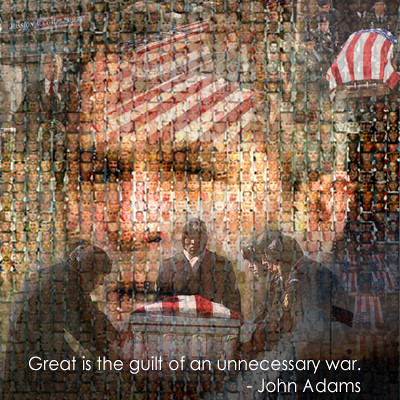
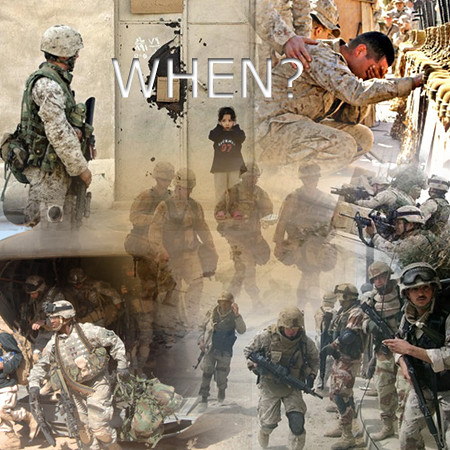
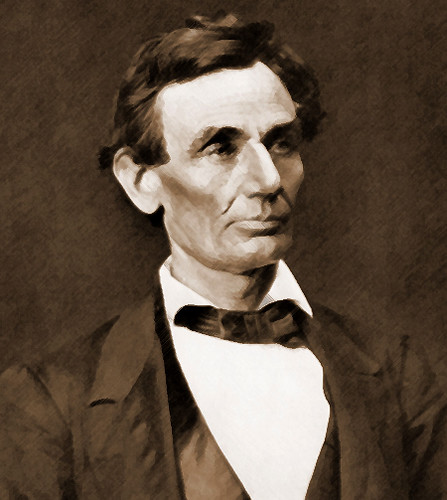
Let every American, every lover of liberty, every well wisher to his posterity, swear by the blood of the Revolution, never to violate in the least particular, the laws of the country; and never to tolerate their violation by others.

As the patriots of seventy-six did to the support of the Declaration of Independence, so to the support of the Constitution and Laws, let every American pledge his life, his property, and his sacred honor; let every man remember that to violate the law, is to trample on the blood of his father, and to tear the charter of his own, and his children's liberty.

Let reverence for the laws, be breathed by every American mother, to the lisping babe, that prattles on her lap; let it be taught in schools, in seminaries, and in colleges; let it be written in Primers, spelling books, and in Almanacs; let it be preached from the pulpit, proclaimed in legislative halls, and enforced in courts of justice. And, in short, let it become the political religion of the nation; and Let the old and the young, the rich and the poor, the grave and the gay, of all sexes and tongues, and colors and conditions, sacrifice unceasingly upon its altars.

While ever a state of feeling, such as this, shall universally, or even, very generally prevail throughout the nation, vain will be every effort, and fruitless every attempt, to subvert our national freedom.


- Abraham Lincoln, January 27, 1838
  Address Before the Young Men's Lyceum of Springfield, Illinois

Friday, January 30, 2009

Take them home


Lincoln was haunted by the Civil War and the death and bloodshed that he couldn't bring to an end. One has only to see how he aged in the five years he served as president to see the enormous burden he carried.

At least he didn't deliberately start the war that broke out shortly after he took office. In Lincoln's first inaugural address, he all but begged the South to reconsider withdrawing from the Union; it was the Confederacy that fired on Fort Sumter, kicking off four years of carnage.

Not so with Bush and the war in Iraq.

I am haunted by the deaths that have occurred in Iraq and Afghanistan: our trusting soldiers who were deployed to Iraq, believing in our government and that the cause was true... and the millions of civilians who have been killed as a consequence of our invasion.

There is also the issue of the Bush Administration's horrific mismanagement of the search for Bin Laden in Afghanistan. Because... the entire reason for going into Afghanistan was supposed to have been to find Osama Bin Laden.

Eight years later -- where is he? We have no idea.

There are still many questions surrounding the death of Pat Tillman. All we know is that he died by friendly fire, and that the Bush Administration covered this up, lying even to his family. I think of Pat every day as the Super Bowl draws near, and his beloved Cardinals prepare to take the grand stage.

Pat should be here.

As with the veterans of Vietnam, Iraq war vets will likely live with the knowledge that the war in which they fought never should have been waged. I have known many Vietnam vets over the course of my lifetime -- it has been a very bitter pill to swallow.

Even more bitter is the pill left for the families of those who never returned. I'm sure a day will not go by that they will not wonder why their son or daughter died... if not because of WMDs and not because of 9/11. Was it truly only for oil?

All of this is on George W. Bush's head, and there it will remain. But the pain will go on, even now that he is out of office.

Would that we all - people and representatives together - had seen through the Bush madness and stopped this war dead in its tracks. All of us who lived through and remember Vietnam should have stopped this from ever happening. Surely if we were able to pull together in a massive electoral uprising to elect Barack Obama, we could have done something...

I guess we woke up from our fitful sleep a little too late.


Starlight, by the Wailin' Jennys

I have come back to you broken
take me home
And my body bears this trouble
take me home
Take me back to my beginning
Before the hell of night set in
And I came to this border
take me home


I have toured the endless starlight
take me home
I have shattered under midnight
take me home
There are no vultures in this clearing
Except the ones who brought me here
And I'll no longer feed them
take me home


Kingdom come, their will was done
And now the earth is far away
from any kind of heaven
Hallowed be these frozen fields
And every single one of us
still left in want of mercy
Take us home


Now the bells stand still and hollow
take me home
And no one has come to mourn me
take me home
Find me where I close my eyes
Beneath this sky of powerlines
And let me see us clearly
take me home


Kingdom come, their will was done
And now the earth is far away
from any kind of heaven
Hallowed be these frozen fields
And every single one of us
Still left in want of mercy
Take us home...

Labels: , , , ,

Monday, January 12, 2009

Looking back at Lincoln: On January 12, 1848

Lincoln's famous speech before the House of Representatives, concerning President Polk's handling of the war with Mexico. (I'd give anything to have heard heard this in person.)

Speech in United States House of Representatives: The War with Mexico

Mr. Chairman: January 12, 1848

Some, if not all the gentlemen on, the other side of the House, who have addressed the committee within the last two days, have spoken rather complainingly, if I have rightly understood them, of the vote given a week or ten days ago, declaring that the war with Mexico was unnecessarily and unconstitutionally commenced by the President. [2] I admit that such a vote should not be given, in mere party wantonness, and that the one given, is justly censurable, if it have no other, or better foundation. I am one of those who joined in that vote; and I did so under my best impression of the truth of the case. How I got this impression, and how it may possibly be removed, I will now try to show. When the war began, it way my opinion that all those who, because of knowing too little, or because of knowing too much, could not conscientiously approve the conduct of the President, in the beginning of it, should, nevertheless, as good citizens and patriots, remain silent on that point, at least till the war should be ended. Some leading democrats, including Ex President Van Buren, have taken this same view, as I understand them; and I adhered to it, and acted upon it, until since I took my seat here; and I think I should still adhere to it, were it not that the President and his friends will not allow it to be so. Besides the continual effort of the President to argue every silent vote given for supplies, into an endorsement of the justice and wisdom of his conduct---besides that singularly candid paragraph, in his late message in which he tells us that Congress, with great unanimity, only two in the Senate and fourteen in the House dissenting, had declared that, ``by the act of the Republic of Mexico, a state of war exists between that Government and the United States,'' when the same journals that informed him of this, also informed him, that when that declaration stood disconnected from the question of supplies, sixtyseven in the House, and not fourteen merely, voted against it---besides this open attempt to prove, by telling the truth, what he could not prove by telling the whole truth---demanding of all who will not submit to be misrepresented, in justice to themselves, to speak out---besides all this, one of my colleagues (Mr. Richardson) [3] at a very early day in the session brought in a set of resolutions, expressly endorsing the original justice of the war on the part of the President. Upon these resolutions, when they shall be put on their passage I shall be compelled to vote; so that I can not be silent, if I would. Seeing this, I went about preparing myself to give the vote understandingly when it should come. I carefully examined the President's messages, to ascertain what he himself had said and proved upon the point. The result of this examination was to make the impression, that taking for true, all the President states as facts, he falls far short of proving his justification; and that the President would have gone farther with his proof, if it had not been for the small matter, that the truth would not permit him. Under the impression thus made, I gave the vote before mentioned. I propose now to give, concisely, the process of the examination I made, and how I reached the conclusion I did. The President, in his first war message of May 1846, declares that the soil was ours on which hostilities were commenced by Mexico; and he repeats that declaration, almost in the same language, in each successive annual message, thus showing that he esteems that point, a highly essential one. In the importance of that point, I entirely agree with the President. To my judgment, it is the very point, upon which he should be justified, or condemned. In his message of Decr. 1846, it seems to have occurred to him, as is certainly true, that title---ownership---to soil, or any thing else, is not a simple fact; but is a conclusion following one or more simple facts; and that it was incumbent upon him, to present the facts, from which he concluded, the soil was ours, on which the first blood of the war was shed.

Accordingly a little below the middle of page twelve in the message last referred to, he enters upon that task; forming an issue, and introducing testimony, extending the whole, to a little below the middle of page fourteen. Now I propose to try to show, that the whole of this,---issue and evidence---is, from beginning to end, the sheerest deception. The issue, as he presents it, is in these words ``But there are those who, conceding all this to be true, assume the ground that the true western boundary of Texas is the Nueces, instead of the Rio Grande; and that, therefore, in marching our army to the east bank of the latter river, we passed the Texan line, and invaded the teritory of Mexico.'' Now this issue, is made up of two affirmatives and no negative. The main deception of it is, that it assumes as true, that one river or the other is necessarily the boundary; and cheats the superficial thinker entirely out of the idea, that possibly the boundary is somewhere between the two, and not actually at either. A further deception is, that it will let in evidence, which a true issue would exclude. A true issue, made by the President, would be about as follows ``I say, the soil was ours, on which the first blood was shed; there are those who say it was not.''

I now proceed to examine the Presidents evidence, as applicable to such an issue. When that evidence is analized, it is all included in the following propositions:

1. That the Rio Grande was the Western boundary of Louisiana as we purchased it of France in 1803.

2. That the Republic of Texas always claimed the Rio Grande, as her Western boundary.

3. That by various acts, she had claimed it on paper.

4. That Santa Anna, in his treaty with Texas, recognised the Rio Grande, as her boundary.

5. That Texas before, and the U. S. after, annexation had exercised jurisdiction beyond the Nueces---between the two rivers.

6. That our Congress, understood the boundary of Texas to extend beyond the Nueces.

Now for each of these in it's turn.

His first item is, that the Rio Grande was the Western boundary of Louisiana, as we purchased it of France in 1803; and seeming to expect this to be disputed, he argues over the amount of nearly a page, to prove it true; at the end of which he lets us know, that by the treaty of 1819, we sold to Spain the whole country from the Rio Grande eastward, to the Sabine. Now, admitting for the present, that the Rio Grande, was the boundary of Louisiana, what, under heaven, had that to do with the present boundary between us and Mexico? How, Mr. Chairman, the line, that once divided your land from mine, can still be the boundary between us, after I have sold my land to you, is, to me, beyond all comprehension. And how any man, with an honest purpose only, of proving the truth, could ever have thought of introducing such a fact to prove such an issue, is equally incomprehensible. [4] His next piece of evidence is that ``The Republic of Texas always claimed this river (Rio Grande) as her western boundary[.]'' That is not true, in fact. Texas has claimed it, but she has not always claimed it. There is, at least, one distinguished exception. Her state constitution,---the republic's most solemn, and well considered act---that which may, without impropriety, be called her last will and testament revoking all others---makes no such claim. But suppose she had always claimed it. Has not Mexico always claimed the contrary? so that there is but claim against claim, leaving nothing proved, until we get back of the claims, and find which has the better foundation. Though not in the order in which the President presents his evidence, I now consider that class of his statements, which are, in substance, nothing more than that Texas has, by various acts of her convention and congress, claimed the Rio Grande, as her boundary, on paper. I mean here what he says about the fixing of the Rio Grande as her boundary in her old constitution (not her state constitution) about forming congressional districts, counties &c &c. Now all of this is but naked claim; and what I have already said about claims is strictly applicable to this. If I should claim your land, by word of mouth, that certainly would not make it mine; and if I were to claim it by a deed which I had made myself, and with which, you had had nothing to do, the claim would be quite the same, in substance---or rather, in utter nothingness. I next consider the President's statement that Santa Anna in his treaty [5] with Texas, recognised the Rio Grande, as the western boundary of Texas. Besides the position, so often taken that Santa Anna, while a prisoner of war---a captive---could not bind Mexico by a treaty, which I deem conclusive---besides this, I wish to say something in relation to this treaty, so called by the President, with Santa Anna. If any man would like to be amused by a sight of that little thing, which the President calls by that big name, he can have it, by turning to Niles' Register volume 50, page 336. And if any one should suppose that Niles' Register is a curious repository of so mighty a document, as a solemn treaty between nations, I can only say that I learned, to a tolerable degree [of] certainty, by enquiry at the State Department, that the President himself, never saw it any where else. By the way, I believe I should not err, if I were to declare, that during the first ten years of the existence of that document, it was never, by any body, called a treaty---that it was never so called, till the President, in his extremity, attempted, by so calling it, to wring something from it in justification of himself in connection with the Mexican war. It has none of the distinguishing features of a treaty. It does not call itself a treaty. Santa Anna does not therein, assume to bind Mexico; he assumes only to act as the President-Commander-in-chief of the Mexican Army and Navy; stipulates that the then present hostilities should cease, and that he would not himself take up arms, nor influence the Mexican people to take up arms, against Texas during the existence of the war of independence[.] He did not recognise the independence of Texas; he did not assume to put an end to the war; but clearly indicated his expectation of it's continuance; he did not say one word about boundary, and, most probably, never thought of it. It is stipulated therein that the Mexican forces should evacuate the teritory of Texas, passing to the other side of the Rio Grande; and in another article, it is stipulated that, to prevent collisions between the armies, the Texan army should not approach nearer than within five leagues---of what is not said---but clearly, from the object stated it is---of the Rio Grande. Now, if this is a treaty, recognising the Rio Grande, as the boundary of Texas, it contains the singular feauture [sic], of stipulating, that Texas shall not go within five leagues of her own boundary.

Next comes the evidence of Texas before annexation, and the United States, afterwards, exercising jurisdiction beyond the Nueces, and between the two rivers. This actual exercise of jurisdiction, is the very class or quality of evidence we want. It is excellent so far as it goes; but does it go far enough? He tells us it went beyond the Nueces; but he does not tell us it went to the Rio Grande. He tells us, jurisdiction was exercised between the two rivers, but he does not tell us it was exercised over all the teritory between them. Some simple minded people, think it is possible, to cross one river and go beyond it without going all the way to the next---that jurisdiction may be exercised between two rivers without covering all the country between them. I know a man, not very unlike myself, who exercises jurisdiction over a piece of land between the Wabash and the Mississippi; and yet so far is this from being all there is between those rivers, that it is just one hundred and fiftytwo feet long by fifty wide, and no part of it much within a hundred miles of either. He has a neighbour between him and the Mississippi,---that is, just across the street, in that direction---whom, I am sure, he could neither persuade nor force to give up his habitation; but which nevertheless, he could certainly annex, if it were to be done, by merely standing on his own side of the street and claiming it, or even, sitting down, and writing a deed for it.

But next the President tells us, the Congress of the United States understood the state of Texas they admitted into the union, to extend beyond the Nueces. Well, I suppose they did. I certainly so understood it. But how far beyond? That Congress did not understand it to extend clear to the Rio Grande, is quite certain by the fact of their joint resolutions, for admission, expressly leaving all questions of boundary to future adjustment. And it may be added, that Texas herself, is proved to have had the same understanding of it, that our Congress had, by the fact of the exact conformity of her new constitution, to those resolutions.

I am now through the whole of the President's evidence; and it is a singular fact, that if any one should declare the President sent the army into the midst of a settlement of Mexican people, who had never submited, by consent or by force, to the authority of Texas or of the United States, and that there, and thereby, the first blood of the war was shed, there is not one word in all the President has said, which would either admit or deny the declaration. [6] This strange omission, it does seem to me, could not have occurred but by design. My way of living leads me to be about the courts of justice; and there, I have sometimes seen a good lawyer, struggling for his client's neck, in a desparate case, employing every artifice to work round, befog, and cover up, with many words, some [7] point arising in the case, which he dared not admit, and yet could not deny. Party bias may help to make it appear so; but with all the allowance I can make for such bias, it still does appear to me, that just such, and from just such necessity, is the President's struggle in this case. Some time after my colleague (Mr. Richardson) introduced the resolutions I have mentioned, I introduced a preamble, resolution, and interrogatories, [8] intended to draw the President out, if possible, on this hitherto untrodden ground. To show their relevancy, I propose to state my understanding of the true rule for ascertaining the boundary between Texas and Mexico. It is, that wherever Texas was exercising jurisdiction, was hers; and wherever Mexico was exercising jurisdiction, was hers; and that whatever separated the actual exercise of jurisdiction of the one, from that of the other, was the true boundary between them. If, as is probably true, Texas was exercising jurisdiction along the western bank of the Nueces, and Mexico was exercising it along the eastern bank of the Rio Grande, then neither river was the boundary; but the uninhabited country between the two, was. The extent of our teritory in that region depended, not on any treaty-fixed boundary (for no treaty had attempted it) but on revolution. Any people anywhere, being inclined and having the power, have the right to rise up, and shake off the existing government, and form a new one that suits them better. This is a most valuable,---a most sacred right---a right, which we hope and believe, is to liberate the world. Nor is this right confined to cases in which the whole people of an existing government, may choose to exercise it. Any portion of such people that can, may revolutionize, and make their own, of so much of the teritory as they inhabit. More than this, a majority of any portion of such people may revolutionize, putting down a minority, intermingled with, or near about them, who may oppose their movement. Such minority, was precisely the case, of the tories of our own revolution. It is a quality of revolutions not to go by old lines, or old laws; but to break up both, and make new ones. As to the country now in question, we bought it of France in 1803, and sold it to Spain in 1819, according to the President's statements. After this, all Mexico, including Texas, revolutionized against Spain; and still later, Texas revolutionized against Mexico. In my view, just so far as she carried her revolution, by obtaining the actual, willing or unwilling, submission of the people, so far, the country was hers, and no farther. Now sir, for the purpose of obtaining the very best evidence, as to whether Texas had actually carried her revolution, to the place where the hostilities of the present war commenced, let the President answer the interrogatories, I proposed, as before mentioned, or some other similar ones. Let him answer, fully, fairly, and candidly. Let him answer with facts, and not with arguments. Let him remember he sits where Washington sat, and so remembering, let him answer, as Washington would answer. As a nation should not, and the Almighty will not, be evaded, so let him attempt no evasion---no equivocation. And if, so answering, he can show that the soil was ours, where the first blood of the war was shed---that it was not within an inhabited country, or, if within such, that the inhabitants had submitted themselves to the civil authority of Texas, or of the United States, and that the same is true of the site of Fort Brown, then I am with him for his justification. In that case I, shall be most happy to reverse the vote I gave the other day. I have a selfish motive for desiring that the President may do this. I expect to give some votes, in connection with the war, which, without his so doing, will be of doubtful propriety in my own judgment, but which will be free from the doubt if he does so. But if he can not, or will not do this---if on any pretence, or no pretence, he shall refuse or omit it, then I shall be fully convinced, of what I more than suspect already, that he is deeply conscious of being in the wrong---that he feels the blood of this war, like the blood of Abel, is crying to Heaven against him. [9] That originally having some strong motive---what, I will not stop now to give my opinion concerning---to involve the two countries in a war, and trusting to escape scrutiny, by fixing the public gaze upon the exceeding brightness of military glory---that attractive rainbow, that rises in showers of blood---that serpent's eye, that charms to destroy---he plunged into it, and has swept, on and on, till, disappointed in his calculation of the ease with which Mexico might be subdued, he now finds himself, he knows not where. How like the half insane mumbling of a fever-dream, is the whole war part of his late message! At one time telling us that Mexico has nothing whatever, that we can get, but teritory; at another, showing us how we can support the war, by levying contributions on Mexico. At one time, urging the national honor, the security of the future, the prevention of foreign interference, and even, the good of Mexico herself, as among the objects of the war; at another, telling us, that ``to reject indemnity, by refusing to accept a cession of teritory, would be to abandon all our just demands, and to wage the war, bearing all it's expenses, without a purpose or definite object[.]'' So then, the national honor, security of the future, and every thing but teritorial indemnity, may be considered the no-purposes, and indefinite, objects of the war! But, having it now settled that teritorial indemnity is the only object, we are urged to seize, by legislation here, all that he was content to take, a few months ago, and the whole province of lower California to boot, and to still carry on the war---to take all we are fighting for, and still fight on. Again, the President is resolved, under all circumstances, to have full teritorial indemnity for the expenses of the war; but he forgets to tell us how we are to get the excess, after those expenses shall have surpassed the value of the whole of the Mexican teritory. So again, he insists that the separate national existence of Mexico, shall be maintained; but he does not tell us how this can be done, after we shall have taken all her teritory. Lest the questions, I here suggest, be considered speculative merely, let me be indulged a moment in trying [to] show they are not. The war has gone on some twenty months; for the expenses of which, together with an inconsiderable old score, the President now claims about one half of the Mexican teritory; and that, by far the better half, so far as concerns our ability to make any thing out of it. It is comparatively uninhabited; so that we could establish land offices in it, and raise some money in that way. But the other half is already inhabited, as I understand it, tolerably densely for the nature of the country; and all it's lands, or all that are valuable, already appropriated as private property. How then are we to make any thing out of these lands with this incumbrance on them? or how, remove the incumbrance? I suppose no one will say we should kill the people, or drive them out, or make slaves of them, or even confiscate their property. How then can we make much out of this part of the teritory? If the prosecution of the war has, in expenses, already equalled the better half of the country, how long it's future prosecution, will be in equalling, the less valuable half, is not a speculative, b question, pressing closely upon us. And yet it is a question which the President seems to never have thought of. As to the mode of terminating the war, and securing peace, the President is equally wandering and indefinite. First, it is to be done by a more vigorous prossecution of the war in the vital parts of the enemies country; and, after apparantly, talking himself tired, on this point, the President drops down into a half despairing tone, and tells us that ``with a people distracted and divided by contending factions, and a government subject to constant changes, by successive revolutions, the continued success of our arms may fail to secure a satisfactory peace[.]'' Then he suggests the propriety of wheedling the Mexican people to desert the counsels of their own leaders, and trusting in our protection, to set up a government from which we can secure a satisfactory peace; telling us, that ``this may become the only mode of obtaining such a peace.'' But soon he falls into doubt of this too; and then drops back on to the already half abandoned ground of ``more vigorous prossecution.[''] All this shows that the President is, in no wise, satisfied with his own positions. First he takes up one, and in attempting to argue us into it, he argues himself out of it; then seizes another, and goes through the same process; and then, confused at being able to think of nothing same process; and then, confused at being able to think of nothing new, he snatches up the old one again, which he has some time before cast off. His mind, tasked beyond it's power, is running hither and thither, like some tortured creature, on a burning surface, finding no position, on which it can settle down, and be at ease. Again, it is a singular omission in this message, that it, no where intimates when the President expects the war to terminate. At it's beginning, Genl. Scott[10] was, by this same President, driven into disfavor, if not disgrace, for intimating that peace could not be conquered in less than three or four months. But now, at the end of about twenty months, during which time our arms have given us the most splendid successes---every department, and every part, land and water, officers and privates, regulars and volunteers, doing all that men could do, and hundreds of things which it had ever before been thought men could not do,---after all this, this same President gives us a long message, without showing us, that, as to the end, he himself, has, even an immaginary conception. As I have before said, he knows not where he is. He is a bewildered, confounded, and miserably perplexed man. God grant he may be able to show, there is not something about his conscience, more painful than all his mental perplexity!

Annotation

[1] AD, DLC-RTL. The manuscript is followed throughout. Lincoln's emendations, presumably inserted in printer's proof, in the Congressional Globe Appendix, pp. 93-95, are given in footnotes. In addition to these sources for the speech as written, there is the detailed report of the speech as delivered, printed in the Congressional Globe, Thirtieth Congress, First Session, New Series, No. 10, pp. 154-56, which was copied by the Illinois Journal, February 10, 1848.

[2] James K. Polk.

[3] William A. Richardson, Democrat, from Rushville, Illinois, who had been elected to the House to fill the vacancy caused by the resignation of representative-elect Stephen A. Douglas.

[4] In the text of the Congressional Globe Appendix, Lincoln inserted at this point the following sentence: ``The outrage upon common right, of seizing as our own what we have once sold, merely because it was ours before we sold it, is only equalled by the outrage on common sense of any attempt to justify it.''

[5] The text of the so-called ``treaty,'' printed following Lincoln's speech in the Congressional Globe Appendix is as follows: Articles of an agreement entered into between his Excellency David G. Burnet, President of the Republic of Texas, of the one part, and his Excellency General Santa Anna, President-General-in-Chief of the Mexican army, of the other part

ARTICLE 1. General Antonio Lopez de Santa Anna agrees that he will not take up arms, nor will he exercise his influence to cause them to be taken up, against the people of Texas, during the present war of independence.

ART. 2. All hostilities between the Mexican and Texan troops will cease immediately, both by land and water.

ART. 3. The Mexican troops will evacuate the territory of Texas, passing to the other side of the Rio Grande Del Norte.

ART. 4. The Mexican army, in its retreat, shall not take the property of any person without his consent and just indemnification, using only such articles as may be necessary for its subsistence, in cases when the owner may not be present, and remitting to the commander of the army of Texas, or to the Commissioners to be appointed for the adjustment of such matters, an account of the value of the property consumed, the place where taken, and the name of the owner, if it can be ascertained.

ART. 5. That all private property, including cattle, horses, negro slaves, or indentured persons, of whatever denomination, that may have been captured by any portion of the Mexican army, or may have taken refuge in the said army, since the commencement of the late invasion, shall be restored to the commander of the Texan army, or to such other persons as may be appointed by the Government of Texas to receive them.

ART. 6. The troops of both armies will refrain from coming into contact with each other; and to this end, the commander of the army of Texas will be careful not to approach within a shorter distance than five leagues.

ART. 7. The Mexican army shall not make any other delay, on its march, than that which is necessary to take up their hospitals, baggage, &c., and to cross the rivers; any delay not necessary to these purposes to be considered an infraction of this agreement.

ART. 8. By an express to be immediately despatched, this agreement shall be sent to General Vincente Filisola, and to General T. J. Rusk, commander of the Texan army, in order that they may be apprized of its stipulations; and to this end, they will exchange engagements to comply with the same.

ART. 9. That all Texan prisoners now in the possession of the Mexican army, or its authorities, be forthwith released, and furnished with free passports to return to their homes; in consideration of which, a corresponding number of Mexican prisoners, rank and file, now in possession of the Government of Texas, shall be immediately released---the remainder of the Mexican prisoners that continue in the possession of the Government of Texas to be treated with due humanity; any extraordinary comforts that may be furnished them to be at the charge of the Government of Mexico.

ART. 10. General Antonio Lopez de Santa Anna will be sent to Vera Cruz as soon as it shall be deemed proper.

The contracting parties sign this instrument for the above mentioned purposes, in duplicate, at the port of Velasco, this 14th day of May, 1836.

DAVID G. BURNET, President.

JAS. COLLINGSWORTH, Secretary of State.

ANTONIO LOPEZ DE SANTA ANNA.

B. HARDIMAN, Secretary of the Treasury.

P. W. GRAYSON, Attorney-General.

[6] At this point in the Congressional Globe Appendix, Lincoln emended the next sentence as follows: ``In this strange omission chiefly consists the deception of the President's evidence---an omission which, it does seem to me, could scarcely have occurred but by design.''

[7] Lincoln emended ``point arising in the case'' to ``position pressed upon him by the prosecution.''

[8] Supra, under date of December 22, 1847.

[9] At this point Lincoln emended as follows: ``; that he ordered General Taylor into the midst of a peaceful Mexican settlement, purposely to bring on a war; that originally . . .'' etc.

[10] Winfield Scott. Both General Scott and General Taylor were Whigs, and administration leaders feared the increase of their popularity. Scott justifiably suspected the administration of withholding complete co-operation. On January 2, Scott was recalled; on January 31 and April 17, Lincoln voted in favor of resolutions requesting the President to explain the suspension. On April 22, Scott was superseded by General W. O. Butler.

Labels: , , , ,

Saturday, September 27, 2008

The greed within

I actually remember the famous 'Malaise' speech that President Jimmy Carter gave in 1979. I have thought about it from time to time in recent years, as it became obvious we were reaching peak oil. I haven't completely made up my mind about President Jimmy Carter's entire legacy, in regards to foreign policy; but I do know that he warned us that we would have to change our own expectations, or our future would be bleak.

Of course, we didn't want to change. We wanted everything, no strings attached. And so we embraced Reagan's promises of a joyful, prosperous future complete with military dominance, big cars and basically whatever we wanted. We ourselves... chose greed. The rampant greed we see today on Wall Street, in our corporations and in our government -- we chose this ourselves.

And now our own folly has come home to roost.

Even now we are blaming our government, Wall Street and the corporations (I know I have) for the economic mess in which we find ourselves. We are blaming everyone it seems but ourselves. But in the end... wasn't it 'we the people' who believed we deserved and should have it all? Just look around at the ridiculous number of wildly oversized SUVs still out there on the road - even though gas prices are skyrocketing to $4 a gallon. They are completely unsustainable, but their owners just won't give them up. Apparently they'd give up freedom... before their right to drive a tank.

This has led me to ponder when we Americans morphed from the 'Greatest Generation;' the generation that survived the Depression, fought World War II and then kicked off our productive boom years... into the greedy entitled consumers we are today. What the hell happened to us?

Maybe this is good for our nation. Maybe this is the only way we can learn, can wake up and join our neighbors in the entire rest of the world. Whether it is good for us or not -- it was predictable. Carter himself saw it coming, and was ridiculed and rejected by nearly everyone. Carter... who had solar panels installed on the White House roof. How symbolic that Reagan had them removed as soon as he moved in.

Personal responsibility was no longer 'in,' like it was during WWII and during the 1950s. And so we rejected Carter, rejected responsibility, and embraced the unsustainable dream. We can blame Wall Street all we want, but we'd better also look in the mirror.

Here it is - the famous 'Malaise' speech of 1979:

President Jimmy Carter, in a televised speech, July 15, 1979.

Good evening. This is a special night for me. Exactly three years ago, on July 15, 1976, I accepted the nomination of my party to run for president of the United States.

I promised you a president who is not isolated from the people, who feels your pain, and who shares your dreams and who draws his strength and his wisdom from you.

During the past three years I've spoken to you on many occasions about national concerns, the energy crisis, reorganizing the government, our nation's economy, and issues of war and especially peace. But over those years the subjects of the speeches, the talks, and the press conferences have become increasingly narrow, focused more and more on what the isolated world of Washington thinks is important. Gradually, you've heard more and more about what the government thinks or what the government should be doing and less and less about our nation's hopes, our dreams, and our vision of the future.

Ten days ago I had planned to speak to you again about a very important subject -- energy. For the fifth time I would have described the urgency of the problem and laid out a series of legislative recommendations to the Congress. But as I was preparing to speak, I began to ask myself the same question that I now know has been troubling many of you. Why have we not been able to get together as a nation to resolve our serious energy problem?

It's clear that the true problems of our Nation are much deeper -- deeper than gasoline lines or energy shortages, deeper even than inflation or recession. And I realize more than ever that as president I need your help. So I decided to reach out and listen to the voices of America.

I invited to Camp David people from almost every segment of our society -- business and labor, teachers and preachers, governors, mayors, and private citizens. And then I left Camp David to listen to other Americans, men and women like you.

It has been an extraordinary ten days, and I want to share with you what I've heard. First of all, I got a lot of personal advice. Let me quote a few of the typical comments that I wrote down.

This from a southern governor: "Mr. President, you are not leading this nation -- you're just managing the government."

"You don't see the people enough any more."

"Some of your Cabinet members don't seem loyal. There is not enough discipline among your disciples."

"Don't talk to us about politics or the mechanics of government, but about an understanding of our common good."

"Mr. President, we're in trouble. Talk to us about blood and sweat and tears."

"If you lead, Mr. President, we will follow."

Many people talked about themselves and about the condition of our nation.

This from a young woman in Pennsylvania: "I feel so far from government. I feel like ordinary people are excluded from political power."

And this from a young Chicano: "Some of us have suffered from recession all our lives."

"Some people have wasted energy, but others haven't had anything to waste."

And this from a religious leader: "No material shortage can touch the important things like God's love for us or our love for one another."

And I like this one particularly from a black woman who happens to be the mayor of a small Mississippi town: "The big-shots are not the only ones who are important. Remember, you can't sell anything on Wall Street unless someone digs it up somewhere else first."

This kind of summarized a lot of other statements: "Mr. President, we are confronted with a moral and a spiritual crisis."

Several of our discussions were on energy, and I have a notebook full of comments and advice. I'll read just a few.

"We can't go on consuming 40 percent more energy than we produce. When we import oil we are also importing inflation plus unemployment."

"We've got to use what we have. The Middle East has only five percent of the world's energy, but the United States has 24 percent."

And this is one of the most vivid statements: "Our neck is stretched over the fence and OPEC has a knife."

"There will be other cartels and other shortages. American wisdom and courage right now can set a path to follow in the future."

This was a good one: "Be bold, Mr. President. We may make mistakes, but we are ready to experiment."

And this one from a labor leader got to the heart of it: "The real issue is freedom. We must deal with the energy problem on a war footing."

And the last that I'll read: "When we enter the moral equivalent of war, Mr. President, don't issue us BB guns."

These ten days confirmed my belief in the decency and the strength and the wisdom of the American people, but it also bore out some of my long-standing concerns about our nation's underlying problems.

I know, of course, being president, that government actions and legislation can be very important. That's why I've worked hard to put my campaign promises into law -- and I have to admit, with just mixed success. But after listening to the American people I have been reminded again that all the legislation in the world can't fix what's wrong with America. So, I want to speak to you first tonight about a subject even more serious than energy or inflation. I want to talk to you right now about a fundamental threat to American democracy.

I do not mean our political and civil liberties. They will endure. And I do not refer to the outward strength of America, a nation that is at peace tonight everywhere in the world, with unmatched economic power and military might.

The threat is nearly invisible in ordinary ways. It is a crisis of confidence. It is a crisis that strikes at the very heart and soul and spirit of our national will. We can see this crisis in the growing doubt about the meaning of our own lives and in the loss of a unity of purpose for our nation.

The erosion of our confidence in the future is threatening to destroy the social and the political fabric of America.

The confidence that we have always had as a people is not simply some romantic dream or a proverb in a dusty book that we read just on the Fourth of July.

It is the idea which founded our nation and has guided our development as a people. Confidence in the future has supported everything else -- public institutions and private enterprise, our own families, and the very Constitution of the United States. Confidence has defined our course and has served as a link between generations. We've always believed in something called progress. We've always had a faith that the days of our children would be better than our own.

Our people are losing that faith, not only in government itself but in the ability as citizens to serve as the ultimate rulers and shapers of our democracy. As a people we know our past and we are proud of it. Our progress has been part of the living history of America, even the world. We always believed that we were part of a great movement of humanity itself called democracy, involved in the search for freedom, and that belief has always strengthened us in our purpose. But just as we are losing our confidence in the future, we are also beginning to close the door on our past.

In a nation that was proud of hard work, strong families, close-knit communities, and our faith in God, too many of us now tend to worship self-indulgence and consumption. Human identity is no longer defined by what one does, but by what one owns. But we've discovered that owning things and consuming things does not satisfy our longing for meaning. We've learned that piling up material goods cannot fill the emptiness of lives which have no confidence or purpose.

The symptoms of this crisis of the American spirit are all around us. For the first time in the history of our country a majority of our people believe that the next five years will be worse than the past five years. Two-thirds of our people do not even vote. The productivity of American workers is actually dropping, and the willingness of Americans to save for the future has fallen below that of all other people in the Western world.

As you know, there is a growing disrespect for government and for churches and for schools, the news media, and other institutions. This is not a message of happiness or reassurance, but it is the truth and it is a warning.

These changes did not happen overnight. They've come upon us gradually over the last generation, years that were filled with shocks and tragedy.

We were sure that ours was a nation of the ballot, not the bullet, until the murders of John Kennedy and Robert Kennedy and Martin Luther King Jr. We were taught that our armies were always invincible and our causes were always just, only to suffer the agony of Vietnam. We respected the presidency as a place of honor until the shock of Watergate.

We remember when the phrase "sound as a dollar" was an expression of absolute dependability, until ten years of inflation began to shrink our dollar and our savings. We believed that our nation's resources were limitless until 1973, when we had to face a growing dependence on foreign oil.

These wounds are still very deep. They have never been healed. Looking for a way out of this crisis, our people have turned to the Federal government and found it isolated from the mainstream of our nation's life. Washington, D.C., has become an island. The gap between our citizens and our government has never been so wide. The people are looking for honest answers, not easy answers; clear leadership, not false claims and evasiveness and politics as usual.

What you see too often in Washington and elsewhere around the country is a system of government that seems incapable of action. You see a Congress twisted and pulled in every direction by hundreds of well-financed and powerful special interests. You see every extreme position defended to the last vote, almost to the last breath by one unyielding group or another. You often see a balanced and a fair approach that demands sacrifice, a little sacrifice from everyone, abandoned like an orphan without support and without friends.

Often you see paralysis and stagnation and drift. You don't like it, and neither do I. What can we do?

First of all, we must face the truth, and then we can change our course. We simply must have faith in each other, faith in our ability to govern ourselves, and faith in the future of this nation. Restoring that faith and that confidence to America is now the most important task we face. It is a true challenge of this generation of Americans.

One of the visitors to Camp David last week put it this way: "We've got to stop crying and start sweating, stop talking and start walking, stop cursing and start praying. The strength we need will not come from the White House, but from every house in America."

We know the strength of America. We are strong. We can regain our unity. We can regain our confidence. We are the heirs of generations who survived threats much more powerful and awesome than those that challenge us now. Our fathers and mothers were strong men and women who shaped a new society during the Great Depression, who fought world wars, and who carved out a new charter of peace for the world.

We ourselves are the same Americans who just ten years ago put a man on the Moon. We are the generation that dedicated our society to the pursuit of human rights and equality. And we are the generation that will win the war on the energy problem and in that process rebuild the unity and confidence of America.

We are at a turning point in our history. There are two paths to choose. One is a path I've warned about tonight, the path that leads to fragmentation and self-interest. Down that road lies a mistaken idea of freedom, the right to grasp for ourselves some advantage over others. That path would be one of constant conflict between narrow interests ending in chaos and immobility. It is a certain route to failure.

All the traditions of our past, all the lessons of our heritage, all the promises of our future point to another path, the path of common purpose and the restoration of American values. That path leads to true freedom for our nation and ourselves. We can take the first steps down that path as we begin to solve our energy problem.

Energy will be the immediate test of our ability to unite this nation, and it can also be the standard around which we rally. On the battlefield of energy we can win for our nation a new confidence, and we can seize control again of our common destiny.

In little more than two decades we've gone from a position of energy independence to one in which almost half the oil we use comes from foreign countries, at prices that are going through the roof. Our excessive dependence on OPEC has already taken a tremendous toll on our economy and our people. This is the direct cause of the long lines which have made millions of you spend aggravating hours waiting for gasoline. It's a cause of the increased inflation and unemployment that we now face. This intolerable dependence on foreign oil threatens our economic independence and the very security of our nation. The energy crisis is real. It is worldwide. It is a clear and present danger to our nation. These are facts and we simply must face them.

What I have to say to you now about energy is simple and vitally important.

Point one: I am tonight setting a clear goal for the energy policy of the United States. Beginning this moment, this nation will never use more foreign oil than we did in 1977 -- never. From now on, every new addition to our demand for energy will be met from our own production and our own conservation. The generation-long growth in our dependence on foreign oil will be stopped dead in its tracks right now and then reversed as we move through the 1980s, for I am tonight setting the further goal of cutting our dependence on foreign oil by one-half by the end of the next decade -- a saving of over 4-1/2 million barrels of imported oil per day.

Point two: To ensure that we meet these targets, I will use my presidential authority to set import quotas. I'm announcing tonight that for 1979 and 1980, I will forbid the entry into this country of one drop of foreign oil more than these goals allow. These quotas will ensure a reduction in imports even below the ambitious levels we set at the recent Tokyo summit.

Point three: To give us energy security, I am asking for the most massive peacetime commitment of funds and resources in our nation's history to develop America's own alternative sources of fuel -- from coal, from oil shale, from plant products for gasohol, from unconventional gas, from the sun.

I propose the creation of an energy security corporation to lead this effort to replace 2-1/2 million barrels of imported oil per day by 1990. The corporation I will issue up to $5 billion in energy bonds, and I especially want them to be in small denominations so that average Americans can invest directly in America's energy security.

Just as a similar synthetic rubber corporation helped us win World War II, so will we mobilize American determination and ability to win the energy war. Moreover, I will soon submit legislation to Congress calling for the creation of this nation's first solar bank, which will help us achieve the crucial goal of 20 percent of our energy coming from solar power by the year 2000.

These efforts will cost money, a lot of money, and that is why Congress must enact the windfall profits tax without delay. It will be money well spent. Unlike the billions of dollars that we ship to foreign countries to pay for foreign oil, these funds will be paid by Americans to Americans. These funds will go to fight, not to increase, inflation and unemployment.

Point four: I'm asking Congress to mandate, to require as a matter of law, that our nation's utility companies cut their massive use of oil by 50 percent within the next decade and switch to other fuels, especially coal, our most abundant energy source.

Point five: To make absolutely certain that nothing stands in the way of achieving these goals, I will urge Congress to create an energy mobilization board which, like the War Production Board in World War II, will have the responsibility and authority to cut through the red tape, the delays, and the endless roadblocks to completing key energy projects.

We will protect our environment. But when this nation critically needs a refinery or a pipeline, we will build it.

Point six: I'm proposing a bold conservation program to involve every state, county, and city and every average American in our energy battle. This effort will permit you to build conservation into your homes and your lives at a cost you can afford.

I ask Congress to give me authority for mandatory conservation and for standby gasoline rationing. To further conserve energy, I'm proposing tonight an extra $10 billion over the next decade to strengthen our public transportation systems. And I'm asking you for your good and for your nation's security to take no unnecessary trips, to use carpools or public transportation whenever you can, to park your car one extra day per week, to obey the speed limit, and to set your thermostats to save fuel. Every act of energy conservation like this is more than just common sense -- I tell you it is an act of patriotism.

Our nation must be fair to the poorest among us, so we will increase aid to needy Americans to cope with rising energy prices. We often think of conservation only in terms of sacrifice. In fact, it is the most painless and immediate way of rebuilding our nation's strength. Every gallon of oil each one of us saves is a new form of production. It gives us more freedom, more confidence, that much more control over our own lives.

So, the solution of our energy crisis can also help us to conquer the crisis of the spirit in our country. It can rekindle our sense of unity, our confidence in the future, and give our nation and all of us individually a new sense of purpose.

You know we can do it. We have the natural resources. We have more oil in our shale alone than several Saudi Arabias. We have more coal than any nation on Earth. We have the world's highest level of technology. We have the most skilled work force, with innovative genius, and I firmly believe that we have the national will to win this war.

I do not promise you that this struggle for freedom will be easy. I do not promise a quick way out of our nation's problems, when the truth is that the only way out is an all-out effort. What I do promise you is that I will lead our fight, and I will enforce fairness in our struggle, and I will ensure honesty. And above all, I will act. We can manage the short-term shortages more effectively and we will, but there are no short-term solutions to our long-range problems. There is simply no way to avoid sacrifice.

Twelve hours from now I will speak again in Kansas City, to expand and to explain further our energy program. Just as the search for solutions to our energy shortages has now led us to a new awareness of our Nation's deeper problems, so our willingness to work for those solutions in energy can strengthen us to attack those deeper problems.

I will continue to travel this country, to hear the people of America. You can help me to develop a national agenda for the 1980s. I will listen and I will act. We will act together. These were the promises I made three years ago, and I intend to keep them.

Little by little we can and we must rebuild our confidence. We can spend until we empty our treasuries, and we may summon all the wonders of science. But we can succeed only if we tap our greatest resources -- America's people, America's values, and America's confidence.

I have seen the strength of America in the inexhaustible resources of our people. In the days to come, let us renew that strength in the struggle for an energy secure nation.

In closing, let me say this: I will do my best, but I will not do it alone. Let your voice be heard. Whenever you have a chance, say something good about our country. With God's help and for the sake of our nation, it is time for us to join hands in America. Let us commit ourselves together to a rebirth of the American spirit. Working together with our common faith we cannot fail.

Thank you and good night.

Good night indeed. And good luck.

Labels: , , , , , ,

Sunday, September 07, 2008

Real Patriotism: First, obey the law

I guess this is the face of real American patriotism... the determination to remain true to the law, the Geneva Convention, and our own ideology in the face of Neocon lawlessness.

This is the story of a man who enlisted in good faith but has now deserted the Army; for fear that he will be forced to take a role in torturing captives, which he sees (rightfully) as a war crime.

From the Toronto Star:

Jemley argues that as one of only a small number of Arabic linguists with top security clearance, he could be forced to violate international law by participating in the interrogations of terrorism suspects. It was something he hadn't considered when he enlisted in 2005 and was handpicked to undergo two years of intense training due to his adeptness with languages.

Only last February did he discover that his government had sanctioned new rules on how terrorism suspects could be interrogated. He believes it's torture and when he realized he might be asked to be a part of it, he fled.

"It's a soldier's obligation to say `no' if their commander is doing things that are criminally complicit," Jemley, now 42, said in a recent interview in Toronto. "I think everyone is agreeing now that torture is really what has been going on ... I have every reason to believe that from my small pool that I belong to, with my credentials, that I'd be ordered to do such things."

Labels: , , , , ,

Wednesday, July 30, 2008

Here they come again

This from the ACLU; the guys who keep fighting for our Constitutional rights in the courts -- while Congress is lunching with lobbyists:

Attorney General Michael Mukasey is demanding that Congress issue a new declaration of war so that anyone that this president or the next one declares to be an "enemy combatant" can be held indefinitely without a trial.

The new declaration of war would make the entire globe — including the United States itself — a “battlefield” where the president decides who will be locked up forever.

With only five weeks left in the Congressional schedule and only six months left in the Bush presidency, Mukasey’s ridiculous power grab should be laughed out of town. But given this Congress’ track record, the Mukasey proposal is no laughing matter. Especially because it also includes a cover-up of the Bush administration’s systemic torture and abuse of detainees.

We can’t take for granted that Congress will reject this outrageous proposal. We have to meet it with an immediate wall of protest that says to Congress: “Don’t you dare.”

Once again, I contacted my Representative and told him to reject this latest power grab by Bush and Mukasey.

You can do the same thing here.

Another day... another power grab. They just keep coming. Its a bit like playing 'Space Invaders,' with our freedom on the line.

Labels: , , , ,

Monday, September 10, 2007

The cost


Nobody is ever 'home by Christmas.'

Labels: , , , , , ,

Saturday, September 01, 2007

My neighbor, John

Tonight I sat down with great expectations to watch my neighbor John Mellencamp on Real time with Bill Maher. Mellencamp is very quiet about his political leanings here in Indiana; but his music is the voice of the quiet, tolerant Midwestern liberal living in a 'red state;' trying always to cut through the propaganda that seems to hold our neighbors in a trance. When I heard him describing the 'Great Swindle,' I wanted to leap off the couch and cheer.

I was listening to him just now explain, at Bill's request, about 'what is going on in the middle part of America.'

Bill commented on John's patriotism (without judging it, but...) and John commented that people in this part of the country are very patriotic. Yes, that is true. And as he also pointed out... the ones that do vote for a 'Fred Thompson in his red pickup truck' are naive.

As John put it, they tell the truth; so why should they doubt someone else's word? And what's wrong with being naive?

(Haven't found a video from tonight's show yet; watching for one.)


This royally pissed off Maher, but I see John's point. Because I see this all around me too. That Hoosiers tend to expect that people will naturally do what they say they will do - the 'right thing' - and to be honest in their dealings isn't the problem. The problem is the way in which they have been betrayed... and the way that their faith in decency and governmental authority - and especially their patriotism - has been used against them.

JM: I see it. I see it all the time, and I can't understand. My wife and I would drive through small communities in Indiana and go 'We don't understand these Bush/Cheney signs in front of these peoples' houses.' But they were... swindled.

BM: Isn't there something to telling the people to be more cynical, to quote one of my old lines?

JM: But I don't know if I want to go through my life being cynical.

BM: It's better than going through life being swindled.

JM: But I don't like either one!


And there is the great Hoosier dilemma.

I keep insisting that Hoosiers are good, 'salt of the earth' people. Most would give you the shirt off their backs. I moved back here because I missed that; the friendliness, and the offhand generosity.

People know their neighbors here. If there is a storm, people check on each other. When there is an ice storm out here, we all pitch in to clear the road. People share tomato crops, stop and talk over the back fence, and still take walks in the evening. People talk to 'total strangers' in the grocery checkout line.

I never really fit in anywhere else I lived, because I was raised in this environment. There is an openness, a trustfulness that I was raised with here in Indiana, that I have never found anywhere else. I grew up barefoot in the summers, and we never locked our doors at night.

Yes - I talk to people in grocery checkout lines. I've been embarrassing my husband for years. Now he finally gets it. In New York City, people were horrified and immediately looked away. In Chicago, they gave me odd looks, but being the Midwest, they were amusedly tolerant. In Arizona, people looked away in discomfort, as if I had invaded their space by talking to them.

Now that I am home, we're all back to chatting as we stand in line... and it feels good.

I guess I don't like living among cynical people.

And before people jump on me (fellow Hoosiers) about the mean people among us; the haters, remember that there are mean people everywhere (here they wear sheets.) But my own experiences have been that there are many more decent, good people in my area than bad apples. Actually, other than tailgaters, I can't remember the last time I encountered a nasty, mean person around here.

But we're all very careful to avoid talking politics these days. Because we really do prefer getting along. One of the more painful developments under Bush rule, is the way the media has fanned divisions between those of differing ideologies; fostering a hateful 'us verses them' divide between liberal and conservative. Those of us who are liberal tend not to understand where this is coming from because we don't listen to daytime radio or O'Reilly. But at times we see the results of their work.

What a terrific - and well orchestrated - way to divide and conquer us.

Erosion of trust is so apparent in a friendly place like Indiana, where liberals and conservatives have mostly lived side by side as neighbors, farmed and rubbed shoulders in our famous (if dangerous) outdoor farmer's markets, and participated together in our local communities.

Why on earth would we be enemies? As John pointed out - and what I keep struggling to express to my own conservative neighbors - we have a mutual enemy trying to enslave us all. Shouldn't we be pulling together against these wealthy elitists that are sending our jobs overseas, feeding us tainted food, ruining our schools and allowing our infrastructure to decay all around us, withholding desperately needed health care, looting our national treasury and sending our kids off to die for their oil profits?

I mean -- isn't this a mutual problem?

This song really says it all.


Yes, many people here are conservative, patriotic and religious. But until the neocons started poisoning their minds, most of them were patriotic in a good way; people in this state send their kids to Iraq because they believe in duty to country. Only now are they realizing, belatedly, that they have been betrayed.

People here are religious (for the most part) in a good way as well. But there is something there... indoctrination in these conservative churches that teaches them to respect and never question authority.

I used to hear them preaching this blind obedience on the radio every Sunday (it was impossible to get anything else on the Sunday airwaves when I was a kid. We also still can't buy alcohol on a Sunday; including wine, which I often thought was quite ironic, having been raised a Catholic. Can't buy it, but you can have a sip at church.)

This indoctrination has I believe led to an unwillingness or inability to question authority; and that has made these people easy victims, as John put it, for the 'Great Swindle.'

Because they were raised to believe that people are basically honest, upstanding and honorable... they were caught totally off guard by the neocons. I have to keep reminding people; not all Republicans are neocons and many Republican citizens consider themselves 'Republican' based on an illusionary brand that turned into a snare: a trap that was baited with their ideal of honor and good citizenship.

Beware their wrath as they learn the truth.

Do they get it yet? I think they are starting to, in greater and greater numbers, in spite of the media propaganda. The scandals, the lies, the greed... this isn't how we do things here.

Labels: , , , ,

Tuesday, August 14, 2007

War

What difference does it make to the dead, the orphans, and the homeless, whether the mad destruction is wrought under the name of totalitarianism or the holy name of liberty and democracy? - Gandhi

Labels: ,

Saturday, August 11, 2007

A. Lincoln: Endless war

After writing my original post, in which I asked my late friend Abraham Lincoln if he might speak on my behalf concerning our loss of constitutional protections, I mentioned my - our frustration with this endless war, and our president's incomprehensible statements in its defense.

As it turns out, Mr. Lincoln has plenty of experience with stubborn, clueless presidents and 'endless wars.' Recalling his own, frustrating days in Congress, he will now address the members of the 110th Congress on the subject of 'mentally perplexed' presidents... and war.

I have once again offered to take this letter down as dictation (I serve at the pleasure of the president.) My words will be identifiable as regular type; anything written by Mr. Lincoln will be in

blockquotes;


with the addition that I will make use of strikeouts to enhance readability ( Mexico becomes Iraq; it should be clear.)

Sincerely, M

____________________________________________


Gentlemen and Ladies of the Congress:

I would be remiss in my responsibility as former president of this great nation if I did not write to you today; and speaking on behalf of all who have died for the honor of this nation, I must address your abysmal record with regard to the continuation of this illegal and immoral war with the once sovereign nation of Iraq.

That you have so far failed in your duty to end this blatantly illegal war; and that you have so willingly ceded your rightful powers to control the flow of money to said war, and in that you have abdicated your other constitutionally given powers of oversight which are your rightful duties as the legislative branch of this government -- all of this surprises and confounds me.

It is your responsibility to control the monies that will be used for this war, and so ensure that the public interest has not been abused. Ladies and gentlemen of Congress: this is your duty to the people of this nation, and to future generations. May I also suggest that it is also your duty to those who came before you; those of your ancestors who have given so much that you might enjoy the freedom and prosperity in which you live today.

The people of this nation do not want war. It is your duty as representatives of the citizenry to uphold their faith and put an end to it. You must find the means, and with all possible haste, to bring this loss of life, money and national honor to an immediate close.

As for the irregularities that have taken place within this administration; the responsibility rests with Congress to protect and defend the Constitution, from all enemies foreign AND DOMESTIC. As you have all sworn oaths to defend our Constitution, you must not waver from this duty; for history will assail you, and your children's children curse your names if you do not rescue the rule of law and justice from the grasp of this expanded, presidential tyranny.

In short:


I am not concerned that you have fallen. I am concerned that you arise.


When the war began, it was my opinion that all those who, because of knowing too little, or because of knowing too much, could not conscientiously approve the conduct of the President, in the beginning of it, should, nevertheless, as good citizens and patriots, remain silent on that point, at least till the war should be ended.

My way of living leads me to be about the courts of justice; and there, I have sometimes seen a good lawyer, struggling for his client's neck, in a desperate case, employing every artifice to work round, befog, and cover up, with many words, some point arising in the case, which he dared not admit, and yet could not deny. Party bias may help to make it appear so; but with all the allowance I can make for such bias, it still does appear to me, that just such, and from just such necessity, is the President's struggle in this case.

I more than suspect already, that he is deeply conscious of being in the wrong---that he feels the blood of this war, like the blood of Abel, is crying to Heaven against him. That originally having some strong motive---what, I will not stop now to give my opinion concerning---to involve the two countries in a war, and trusting to escape scrutiny, by fixing the public gaze upon the exceeding brightness of military glory---that attractive rainbow, that rises in showers of blood---that serpent's eye, that charms to destroy---he plunged into it, and has swept, on and on, till, disappointed in his calculation of the ease with which Mexico Iraq might be subdued, he now finds himself, he knows not where.

How like the half insane mumbling of a fever-dream, is the whole war part of his late message! At one time telling us that Mexico Iraq has nothing whatever, that we can get, but teritory WMDs and terrorists; at another, showing us how we can support the war, by levying contributions on Mexico Iraq at one time, urging the national honor, the security of the future, the prevention of foreign interference, and even, the good of Mexico Iraq herself, as among the objects of the war; at another, telling us, that to reject indemnity, by refusing to accept a cession of teritory "to cut and run, and fail to support democracy would be to abandon all our just demands, and to wage the war, bearing all it's expenses, without a purpose or definite object."

Again, the President is resolved, under all circumstances, to have full teritorial indemnity blank check funding for the expenses of the war; but he forgets to tell us how we are to get the excess, after those expenses shall have surpassed the value of the whole of the Mexican teritory Iraqi oil.

So again, he insists that the separate national existence of Mexico Iraq shall be maintained; but he does not tell us how this can be done, after we shall have taken all her teritory destroyed her infrastructure. Lest the questions, I here suggest, be considered speculative merely, let me be indulged a moment in trying to show they are not.

If the prosecution of the war has, in expenses, already equaled the better half of the country our national budget, how long it's future prosecution, will be in equaling, the less valuable half entire rest of our treasury, is not a speculative, but a practical question, pressing closely upon us. And yet it is a question which the President seems to never have thought of. As to the mode of terminating the war, and securing peace, the President is equally wandering and indefinite.

First, it is to be done by a more vigorous prosecution of the war in the vital parts of the enemies country; and, after apparently, talking himself tired, on this point, the President drops down into a half despairing tone, and tells us that "with a people distracted and divided by contending factions, and a government subject to constant changes, by successive revolutions, the continued success of our arms may fail to secure a satisfactory peace."

Then he suggests the propriety of wheedling the Mexican Iraqi people to desert the counsels of their own leaders, and trusting in our protection, to set up a government from which we can secure a satisfactory peace; telling us, that "this may become the only mode of obtaining such a peace." But soon he falls into doubt of this too; and then drops back on to the already half abandoned ground of more vigorous prosecution.

All this shows that the President is, in no wise, satisfied with his own positions. First he takes up one, and in attempting to argue us into it, he argues himself out of it; then seizes another, and goes through the same process; and then, confused at being able to think of nothing same process; and then, confused at being able to think of nothing new, he snatches up the old one again, which he has some time before cast off.

His mind, tasked beyond it's power, is running hither and thither, like some tortured creature, on a burning surface, finding no position, on which it can settle down, and be at ease.

Again, it is a singular omission in this message, that it, no where intimates when the President expects the war to terminate.

Every department, and every part, land and water, officers and privates, regulars and volunteers, doing all that men could do, and hundreds of things which it had ever before been thought men could not do,---after all this, this same President gives us a long message, without showing us, that, as to the end, he himself, has, even an imaginary conception.

As I have before said, he knows not where he is. He is a bewildered, confounded, and miserably perplexed man. God grant he may be able to show, there is not something about his conscience, more painful than all his mental perplexity!

I carefully examined the President's messages, to ascertain what he himself had said and proved upon the point. The result of this examination was to make the impression, that taking for true, all the President states as facts, he falls far short of proving his justification; and that the President would have gone farther with his proof, if it had not been for the small matter, that the truth would not permit him.

Let the President answer the interrogatories, I proposed, as before mentioned, or some other similar ones. Let him answer, fully, fairly, and candidly. Let him answer with facts, and not with arguments. Let him remember he sits where Washington sat, and so remembering, let him answer, as Washington would answer. As a nation should not, and the Almighty will not, be evaded, so let him attempt no evasion---no equivocation.

Yours truly,

Labels: , , ,

Tuesday, July 17, 2007

Perished from the earth

Over a hundred years ago, Abraham Lincoln gave one of the most stirring speeches in American history:

Four score and seven years ago our fathers brought forth on this continent, a new nation, conceived in Liberty, and dedicated to the proposition that all men are created equal.


Surely the American Civil War as a time of much greater fear and terror than anything we have ever known in our sheltered, spoiled lifetimes.

And yet President Lincoln never demanded that the people BE AFRAID, never cut Congress out of the loop. He created a bipartisan cabinet of brilliant minds to guarantee that the best interests of the nation would be upheld, even at the cost of his own personal comfort (many of them hated him, and openly looked down on him because of his humble background.)

This was no rich men's pawn. This was a president. This man was one of us; and he believed in us.



Lincoln suspended habeas corpus when riots broke out in cities all across the North, and threatened the safety of the masses. (We citizens have never really liked our wars... have we?) And Lincoln later lifted it. We will find out today if our Senate thinks the current suspension of habeas corpus is worth lifting... without a single American city in flames, or even one lawless riot rampaging through our streets. Yes, we will see.

Lincoln was trying to save our nation... not destroy it for his own, personal gain. Lincoln believed in the dream of our nation's founders.

Democracy. Liberty. Justice.

Now we are engaged in a great civil war, testing whether that nation, or any nation so conceived and so dedicated, can long endure.

Yes, wars will do that. Quite a lot of 'testing' goes on during wartime. 58,168 Americans died in the Vietnam war. 54,246 Americans died in Korea. 407,316 Americans died in WWII. 116,708 Americans died in WWI.

558,052 Americans died in the American Civil War, in the course of only 4 years... out of a total national population of about 30 million (today we have a population of 300 million.) Imagine the impact on society, on towns, cities and farms all across America. And imagine... they didn't toss out the Constitution - and Lincoln still conferred with Congress before going to war.
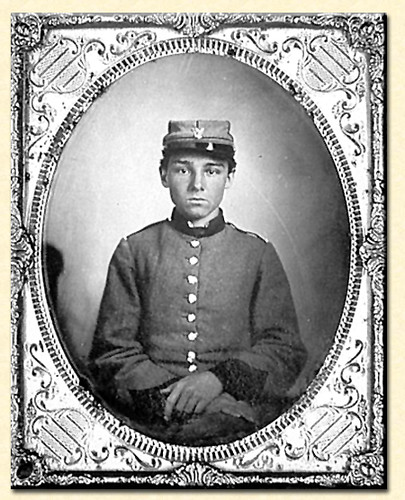


The South fought to form their own, new Constitution; the Union fought to defend the current. Each side was, in their way, fighting for their vision of America... just as today, angry voices on the right and angry voices on the left all fight for their own vision, their own American reality.

We disagree on everything else, but we all do love our country.

Unfortunately for us, corporations do not love our country. They want to rule our country. They want ever more money, ever more power, ever more control. But no, they do not love anything... but money.

I believe that banking institutions are more dangerous to our liberties than standing armies. Already they have raised up a monied aristocracy that has set the government at defiance. - Thomas Jefferson

Commercial shackles are generally unjust, oppressive, and impolitic. - James Madison


We were warned. We have been warned by everyone; from Jefferson to Eisenhower. We didn't listen. We were lured by trinkets and toys, and capitalism grew and grew, until at last it ate democracy.

But back to Gettysburg. Back to the battlefield.


We are met on a great battle-field of that war. We have come to dedicate a portion of that field, as a final resting place for those who here gave their lives that that nation might live. It is altogether fitting and proper that we should do this.

But, in a larger sense, we can not dedicate -- we can not consecrate -- we can not hallow -- this ground. The brave men, living and dead, who struggled here, have consecrated it, far above our poor power to add or detract. The world will little note, nor long remember what we say here, but it can never forget what they did here.


We are engaged, once again, in a war. But this war was never about freedom. This war was never about ideals; although the money powers spun it a way that would inspire yet another generation of idealistic, patriotic warriors to fight.

This war has always been about money.
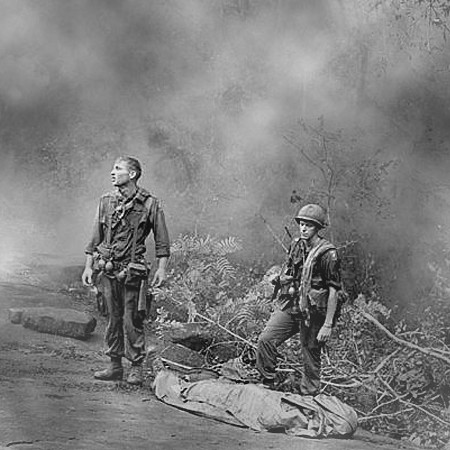


We are daily met on a battlefield of a war. We just haven't yet awakened as a nation to the true nature of our war; and exactly who it is that has declared war on us.

We are misled, co-opted, enslaved... more and more, every day. Our freedom is being stolen from us at every turn by the money powers that lurk in the shadows; the powers that pay for our politicians, own our media, and call the shots. The money that wields the real power behind the scenes in Congress.

Do we think -- do we really think, for one moment, that anything we see is happening without their consent?


It is for us the living, rather, to be dedicated here to the unfinished work which they who fought here have thus far so nobly advanced.


And how do we do that exactly? How do we end this 'perpetual war' that was declared against our will? This war... this endless war that will kill generation after generation of American and 'enemy' warriors alike, along with untold millions of innocent civilians...while destroying our very democracy in the process?

How do we resist this 'war beast' that is intent on killing us?



It is rather for us to be here dedicated to the great task remaining before us -- that from these honored dead we take increased devotion to that cause for which they gave the last full measure of devotion -- that we here highly resolve that these dead shall not have died in vain -- that this nation, under God, shall have a new birth of freedom -- and that government of the people, by the people, for the people, shall not perish from the earth.


Ah, father Abraham... that is the crux of the matter. That is the heart of everything. Because you see, we no longer are a government 'of the people, by the people, and for the people.' That government has indeed, as you once feared, perished from this earth. It happened in increments. It happened with a bill here, an amendment there, and many, many signing statements. It happened while we went to work, went to school, eat, watched TV and slept. It happened quietly and in back rooms.

All across this country, people are demanding justice, demanding the removal of this lawless presidency. For some reason, the Democrats - who we elected to 'make it right' and save our democracy - refuse to act. Most of them refuse to even listen to the voices of the people.

Even Senator Feingold who I have held in the very highest esteem and never once doubted - not for a moment - seems to believe that impeachment is not worth the time.

How can saving our Constitution and our balance of power in government, not to mention our own voice - the voice of the people - how can this not be worth the time?

Lincoln would have thought it worth the time.


Yesterday, Senator Feingold posted a diary on Daily Kos. He responded to the many angry impeachment comments that completely flooded his last diary on Kos. He restated that he feels that impeachment is not a good use of time.

I fully respect the anger and frustration many Americans feel with this Administration. I share much of it. But on balance, I think Congress’s time is much better spent ending the war in Iraq, conducting the oversight that was absent for the last six years, and advancing progressive legislation.


When I try to contact anyone about impeachment (congressman or senator,) I hear much the same... only unlike Senator Feingold, (who did approach us in good faith and is listening,) they speak to me as if talking to a small, confused child. It is as though I must be some left-wing radical to even broach the subject of impeachment. I have to tell them that I actually LEFT THE DEMOCRATIC PARTY OVER THIS before they stop and listen.

I will never belong to any party, ever again. I have lost all faith in parties. Party before nation? NEVER. I put the onus on the Democrats to restore that faith by doing something - anything - to save my country from slipping into a fascist dictatorship.

And perhaps the Democrats are satisfied to have a Democratic dictator rather than a Republican. Perhaps that is the deal that was brokered behind our backs. As long as the uniform is blue instead of red... and the right party 'wins.'


NO.

This was a government built on the rights and the voice of the people; and no one gives a damn about us anymore except when we're actually voting, excepting of course that our elections are now broken too.

And do you know why that is? Because lobbyists now outnumber lawmakers 24-1.


Experience hath shewn, that even under the best forms of government those entrusted with power have, in time, and by slow operations, perverted it into tyranny. - Thomas Jefferson


Why would Congress give a damn about us? We don't pay their way... the corporations do. Perhaps the money powers who own the candidates and the media (except for a couple of mavericks - the ones who are ignored by the media by some strange coincidence;) perhaps these king makers told the Democratic party that they will not receive any endorsements - any money - for next year's election if they push through with impeachment.

Has anyone considered this?

These corporations are growing fat on the Bush Administration's policies, on this contractors' war, on land giveaways, cutbacks on corporate oversight, plundering of the environment, union-bashing, corporate tax cuts... this is pig trough heaven for the corporate world. In fact, corporate lobby representatives now oversee every single oversight agency; and corporations now make the rules and 'police themselves.'


And that is why I now believe that we will never, ever get this back; this government of the people. The whole thing has already gone too far under Bush and Cheney; the corporations will never give up all of this power now. And no one in Congress (other than Dennis and a handful of others) has the courage to stand against them.

One of the starkest Lincoln quotes I've ever seen was written in a letter to an officer during the Civil War. Some people have insisted Lincoln didn't write it, but a historian tracked it down and verified. I was floored when I saw it. How could he have... forseen this? But since that day, I have read many other warnings, going all the way back to our founding fathers. This danger has been looming since the very beginning of our nation.

I see in the near future a crisis approaching that unnerves me and causes me to tremble for the safety of my country. Corporations have been enthroned and an era of corruption in high places will follow, and the money power of the country will endeavor to prolong its reign by working upon the prejudices of the people until all wealth is aggregated in a few hands and the Republic is destroyed. - Abraham Lincoln


If even Senator Feingold says 'do nothing,' it must be because he cannot see any way that Democrats can win next year without keeping impeachment off the table. And what on earth... would make a man like Senator Feingold, who so obviously loves the Constitution and agrees that these tyrants deserve to be impeached; what would make him suggest that impeachment was a bad use of time?



Perhaps the threat of continuing, lawless Neocon rule.

The sad thing... is that if this is true, and it is all about campaign finance: the Democrats are being played.

The corporations will never allow the Democrats to take over Congress or the White House unless they agree to keep things just as they are now. The corporate world will never give up a single tool in their presidential toolbox. I had nothing at all against Hillary; nothing at all... until she became lost in Rupert Murdoch's shadow. And of course Citigroup and Goldman Sachs. And Times Warner. Why would Hillary concern herself with listening to me? I will never have that kind of money.

But I still doubt that they really want Hillary; they'd much rather have a greedy Neocon like Fred Thompson.

I'm imagining a different scenario. I expect they will tell the Democrats to toe that line just a little too long... until the people become increasingly enraged and disaffected.

Then they will toss the people an independent candidate to split the weakened, Democratic vote. And of course, the gravy train will go right on, as if nothing ever happened. Giuliani or Fred Thompson. Probably Thompson because he was a lobbyist. Who better for the new corpocracy?


I hope we shall crush in its birth the aristocracy of our monied corporations which dare already to challenge our government to a trial by strength, and bid defiance to the laws of our country. - Thomas Jefferson


Do I sound cynical? Machiavelli called this hundreds of years ago. Jefferson foresaw it during the birth pangs of our nation. Adams predicted that our fledgling democracy could not survive, but would eventually 'commit suicide.'

It must have leapt while we weren't looking.

If we've lost Senator Feingold, we've lost our Democratic Congress. And they were all we have to represent us in these dark, dark days.

We have no Lincoln... except the one with the tired, sad eyes, staring out from the dusty, faded pictures of our past. The man, the president of the people; who saw the future, and is perhaps still trying to warn us across time and space.

The dogmas of the quiet past, are inadequate to the stormy present. The occasion is piled high with difficulty, and we must rise -- with the occasion. As our case is new, so we must think anew, and act anew. We must disenthrall ourselves, and then we shall save our country. - Abraham Lincoln

Labels: , , , , , , , ,